10
Automotive manufacturers embraced the continuously variable transmission for a straightforward reason: fuel economy. By eliminating fixed gear ratios, a CVT allows an engine to operate at its most efficient RPM regardless of vehicle speed. For drivers, however, the experience has often been defined by apprehension. Dealership service bays and online owner forums are filled with stories of catastrophic failures occurring just outside the factory warranty window, accompanied by replacement estimates that frequently exceed the trade-in value of the car.
While early generations of CVTs were plagued by design flaws, modern units are far more capable than their reputations suggest. Their Achilles heel is not necessarily fragile engineering, but rather an unforgiving intolerance for neglect. A traditional torque-converter automatic can often survive hundreds of thousands of miles of deferred maintenance and hard driving. A CVT will not. To keep one running smoothly beyond 150,000 miles, you have to understand the unique mechanical stresses taking place beneath your center console and adjust your maintenance routine accordingly.
The Engineering Reality: Why CVTs Are Unforgiving
To maintain a CVT effectively, you must understand how fundamentally it differs from a standard planetary-gear automatic. Traditional automatics use sets of interlocking steel gears to transmit power. When a specific gear engages, power transfer is positive and mechanical.
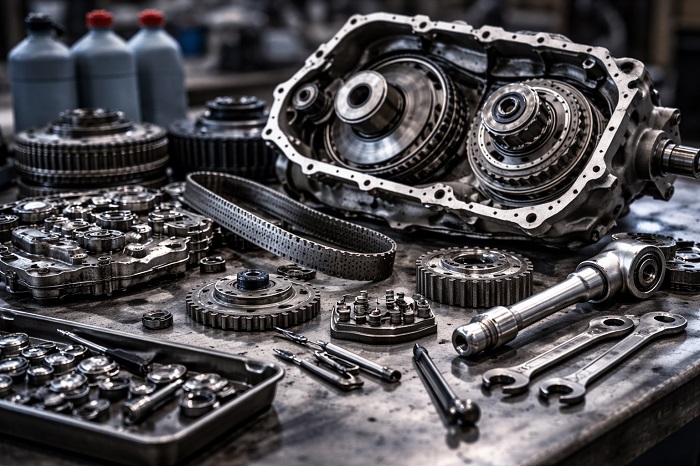
A standard push-belt CVT relies entirely on friction. It uses two variable-diameter pulleys—one connected to the engine input, the other to the drive axles—connected by a segmented steel belt or high-tensile chain. Each pulley consists of two opposing conical halves that move closer together or farther apart via high hydraulic pressure, forcing the belt to ride higher or lower along the cone faces. This dynamic adjustment continuously changes the effective drive ratio.
Because the belt must grip the smooth metal surfaces of the pulleys without slipping, the transmission pump generates immense hydraulic clamping pressure, often between 600 and 800 PSI. If the belt slips even momentarily against the pulley faces, metal-on-metal gouging occurs. Once the micro-polished surfaces of the conical sheaves are scored, the belt will continually catch and shudder across those imperfections, creating a feedback loop of wear that rapidly destroys the assembly. Everything in CVT maintenance revolves around protecting this delicate contact patch.
The Myth of Lifetime Transmission Fluid
The most damaging advice an owner can follow is printed directly in many vehicle owner manuals: the assertion that the transmission fluid is sealed or rated for the lifetime of the vehicle.
In the automotive manufacturing world, lifetime does not mean the vehicle will run indefinitely. It typically means the anticipated lifespan of the factory powertrain warranty, which usually expires between 60,000 and 100,000 miles. Beyond that window, a mechanical failure is an out-of-pocket customer expense rather than a manufacturer liability.
CVT fluid operates in an extraordinarily punishing environment. It serves multiple, conflicting mechanical purposes simultaneously:
-
It acts as a hydraulic medium to move the pulley sheaves under extreme pressure.
-
It lubricates the high-speed bearings supporting the pulley shafts.
-
It carries heat away from the core mechanical components.
-
It functions as a traction fluid, utilizing specialized friction modifiers that prevent the steel belt from slipping across polished metal cones under heavy acceleration.
Over time, the sheer physical forces and localized heat cycles inside the transmission shear down the fluid’s viscosity index improvers. As the fluid thins and its additive package depletes, friction management deteriorates, accelerating sheave wear.
A proactive maintenance schedule requires changing your CVT fluid every 30,000 to 40,000 miles. If you frequently drive in stop-and-go city traffic, live in a mountainous region, or endure hot summers, dropping that interval to 25,000 to 30,000 miles is cheap insurance against a multi-thousand-dollar replacement.
Drain-and-Fill Versus High-Pressure Flushes
When servicing a CVT, the method of fluid exchange is just as critical as the service interval itself. You should almost always opt for a traditional drain-and-fill rather than a high-pressure machine flush.
Commercial transmission flush machines force new fluid through the system under external pressure. Inside a CVT, microscopic metallic particles naturally slough off the belt and pulleys over tens of thousands of miles. Much of this material settles into the bottom of the pan or collects on internal magnetic catch plates.
A high-pressure flush can stir up this sediment and push it directly into the valve body channels. Modern CVT valve bodies contain tiny hydraulic orifices and delicate solenoids with extremely tight clearances. When debris wedges inside these micro-valves, fluid pressure drops erratically, leading to delayed engagement, harsh surging, and sudden belt slippage.
A simple gravity drain-and-fill replaces roughly one-third to one-half of the total fluid capacity without disturbing settled contaminants. Performing a drain-and-fill at regular intervals gradually refreshes the additive package without introducing foreign pressure into sensitive hydraulic circuits.
The Non-Negotiable Rule of Exact OEM Fluid Specifications
With traditional automatics, mechanics can frequently use high-quality aftermarket multi-vehicle fluids with decent results. With a CVT, doing this is an immediate death sentence for the unit.
CVT fluids are not interchangeable. A fluid engineered for a Nissan Jatco unit (such as NS-2 or NS-3) has a vastly different friction profile, kinematic viscosity, and chemical formulation than fluid designed for a Subaru Lineartronic chain-driven transmission, a Honda HCF-2 system, or a Toyota direct-shift unit.
The friction modifiers must match the exact metallurgical composition of the drive belt and the clamping force programmed into the transmission control module. Introducing generic universal fluid or an incompatible specification will disrupt the balance between grip and slip. Always buy fluid directly from the dealership parts counter or verify that the aftermarket bottle explicitly states compliance with your exact factory standard. Saving twenty dollars on fluid is not worth gambling on a complete mechanical overhaul.
Do Not Forget the Secondary Filter
Many vehicle owners believe servicing a CVT only involves draining the fluid and wiping down the bottom pan. However, many widespread CVT designs feature two separate filtration points:
-
The Internal Sump Strainer: Located inside the transmission oil pan, this is typically a plastic-cased metal screen or coarse felt filter designed to catch larger debris before fluid reaches the pump.
-
The External Cartridge Filter: Often overlooked, this smaller, dense paper filter sits inside the transmission cooler line housing or behind a wheel well cover. It traps fine particulate matter that bypasses the primary strainer.
If you change the fluid but leave a saturated cartridge filter in place, fluid circulation to the external cooler becomes restricted. This causes operational temperatures to spike and restricts line pressure across the valve body. Aim to replace the cartridge filter every other fluid change.
Driving Habits That Accelerate Wear
Mechanical longevity is directly tied to operational habits. The way you handle the throttle and shifter influences how much physical shock the belt and pulleys must endure.
The Rolling Directional Change
The quickest way to introduce internal play and stress into a CVT is shifting between Reverse and Drive while the car is still rolling. When you shift directions before coming to a complete stop, the internal forward and reverse clutch packs, as well as the drive belt, are forced to arrest the kinetic energy of the entire vehicle. Always bring your car to an absolute stop with the service brakes before selecting a different gear.
Jackrabbit Launches from a Dead Stop
CVTs struggle most with immediate, high-torque shock loads from a standstill. Stomping on the accelerator pedal from a red light demands instantaneous, maximum clamping pressure from the hydraulic pump before fluid circulation has fully ramped up with engine speed. Rolling into the throttle progressively for the first ten to fifteen feet before applying heavy throttle allows the pulleys to stabilize their grip, dramatically reducing mechanical shock.
Prolonged Creeping on Steep Inclines
When you use the accelerator pedal to hold your car stationary on a steep uphill grade instead of holding the brake pedal, the transmission slips internally to balance gravitational pull against engine torque. This generates intense localized heat inside the torque converter and fluid lines within seconds. Always hold the vehicle with the foot brake or electronic parking brake until you are ready to accelerate.
Heat Management and Transmission Health
Excessive heat is the ultimate killer of continuously variable transmissions. As fluid temperatures climb above 200 degrees Fahrenheit, the chemical chains within the fluid break down at an accelerated rate, and rubber internal seals begin to harden and lose elasticity.
If you regularly drive through long mountain passes, commute through heavy desert traffic, or carry heavy passenger loads, monitor your vehicle for signs of thermal distress. Many modern vehicles will flash a high transmission fluid temperature light or enter a limp-home mode, limiting engine RPM to prevent the fluid from boiling.
If your vehicle routinely experiences high thermal loads, inspect the front of your car to ensure the transmission cooler is free of dirt, leaves, and bent cooling fins. For vehicles with notorious factory cooling limitations, installing a secondary auxiliary transmission fluid cooler can add significant operational life by shedding heat before it compromises fluid integrity.
Warning Signs of Developing Failure
CVT issues rarely appear overnight without warning. Paying attention to subtle changes in driving dynamics gives you the chance to address hydraulic or fluid issues before permanent physical damage occurs.
Ignoring these symptoms will quickly turn a manageable valve body replacement or fluid service into a total structural failure requiring a complete replacement unit.
Treating a continuously variable transmission like a traditional planetary gearbox is the primary reason so many units fail early. A CVT demands clean fluid, correct operating temperatures, and smooth driving inputs. By committing to regular fluid drains, replacing your filters, and eliminating high-shock driving habits, you can bypass the common reliability traps and get hundreds of thousands of dependable miles out of your vehicle.