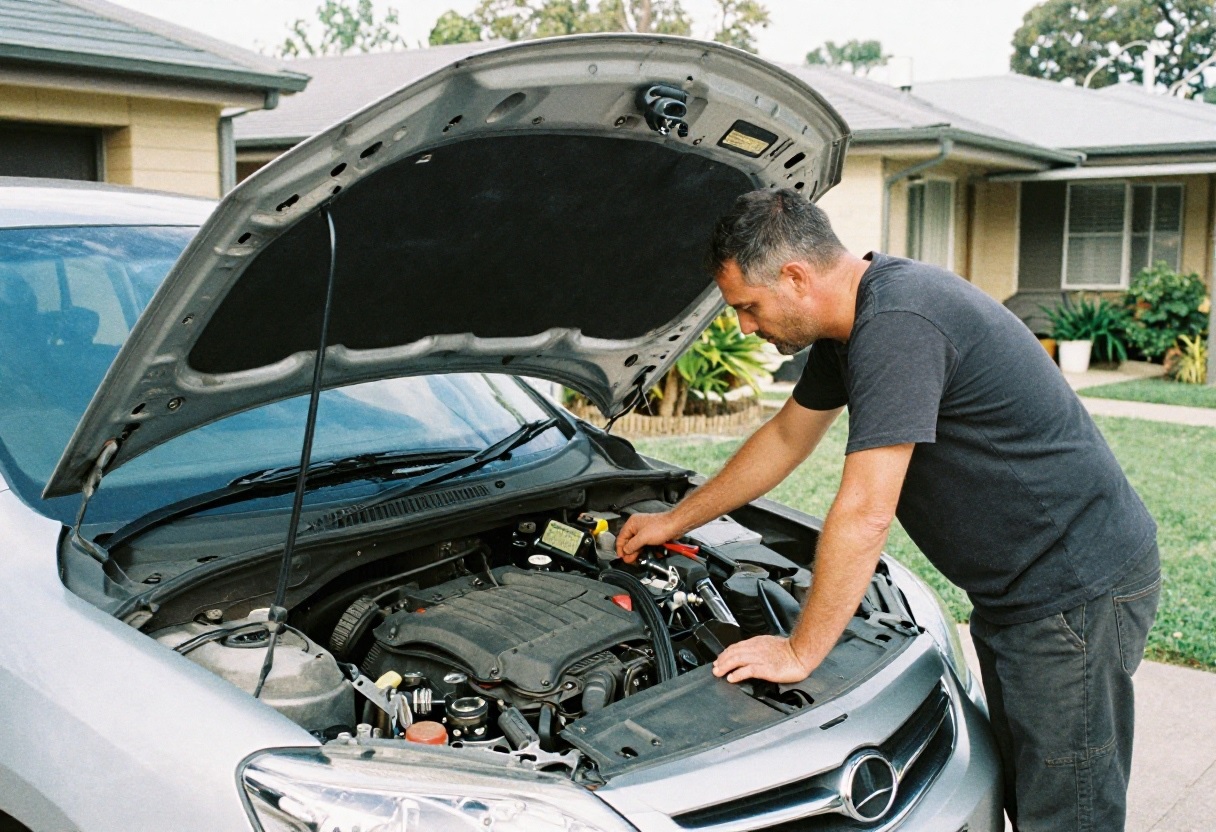
Looking after a car does not have to mean doing every job yourself. An owner can contribute useful observations, keep accurate records, and carry out suitable manual-guided checks without attempting repairs that require specialist equipment or training.
The boundary depends on both the task and the vehicle, as well as the person doing it. A job that looks simple in a video may have model-specific requirements or consequences that are not visible on screen. Choosing a professional is a practical way to manage uncertainty and responsibility.
Start with the consequence of an error
Before pricing tools or ordering parts, consider the consequences of doing the task incorrectly. A mistake could affect stopping, steering, visibility, vehicle support, or a pressurized or energized system. It could also leave a problem hidden until the car is being driven.
Those possibilities matter more than whether a task is commonly described as easy. A short procedure is not necessarily low risk, and experience with one vehicle does not establish competence with another. Even familiar maintenance can involve different fittings or specifications, with access arrangements that vary between models.
For everyday owners without the relevant training and equipment, brakes, steering, fuel systems, refrigerant circuits, and high-voltage systems are clear reasons to use an appropriately qualified professional. Lifting the vehicle or working underneath it introduces another set of hazards. A roadside jack is not a platform for maintenance beneath a car.
Professional help is an alternative when a job is unsuitable for home maintenance. Booking that help keeps the maintenance moving without requiring an owner to attempt work beyond their ability. Postponing it indefinitely does not make the risk disappear.
Use vehicle-specific instructions
The owner’s manual and official maintenance information are the starting point. They explain the manufacturer’s expectations for that vehicle and may identify checks intended for the owner. A general tutorial can offer context, but it cannot establish the correct procedure for every model year, engine, or equipment version.
Read the complete instructions before beginning anything. If the procedure calls for equipment you do not have, a condition you cannot establish, or a technical step you do not understand, stop before taking the vehicle apart. Discovering those limits midway through a job can leave the car unavailable until help arrives.
Do not assume the owner’s manual contains every workshop specification. It is written for owners, not as a complete repair manual. If it does not describe a proposed repair, that absence is not permission to fill the gaps with advice from an unrelated vehicle.
Maintenance timing also belongs to the vehicle’s schedule. Where the manufacturer specifies additional requirements for particular operating conditions, discuss how they apply to actual use. Avoid inventing a shorter or longer interval from internet rules of thumb.
Owner observations can be valuable maintenance work
Useful owner involvement often begins without replacing anything. Noticing a new noise, an unusual smell, a warning message, or a change in operation provides information the technician may not see during a short appointment.
Record what happened and when, along with the circumstances of normal use. For example, a note that a rattle occurs on a cold start is more useful than a guessed diagnosis of a failed component. Include recent repairs or a change in driving patterns where relevant.
Gather information only when it is safe. Do not recreate a dangerous fault or continue driving to obtain a recording, and leave the phone alone while driving. A photograph of a dashboard message while safely parked may be useful; a video taken by the driver in traffic is not an acceptable trade-off.
Visible spots where the car is parked can also be noted without crawling underneath it. Report their location and appearance without assuming which system is leaking. If there is a fuel smell, smoke, a serious warning, or a change affecting control of the car, seek appropriate help rather than treating observation as a reason to keep using it.
Keep basic checks within the manual’s boundaries
Some owner checks are straightforward when the manual describes them and the owner understands the instructions. Tire pressure, for example, should be checked against the vehicle’s specified conditions and placard information, not the maximum figure marked on the tire sidewall.
A visual look at accessible tires can reveal damage or uneven wear worth reporting. It does not establish that the rest of the tire or suspension is sound. An owner check provides useful information to pass on for professional assessment when something looks wrong.
Fluid checks require similar care. Follow the manual’s conditions and access instructions. Do not open a hot cooling system or add an unidentified fluid because a reservoir appears low. Repeated loss needs assessment; topping up does not explain the cause.
Wiper or cabin-filter replacement may be described as owner work on some vehicles. On others, access or fittings make the task less suitable. Visibility and correct assembly still matter, so even a small replacement deserves care and attention to the instructions. If a fitting resists or the instructions do not match the car, stop and ask for help.
Price the whole task, not just the part
A replacement part’s retail price is only one element of DIY cost. Appropriate tools and protective equipment belong in the comparison, along with consumables, cleanup, waste handling, and time. Consider how the car will be moved if the job cannot be completed.
An experienced owner may already have suitable equipment. Someone starting from scratch may need to buy several items for a task they rarely repeat. Neither situation proves that DIY is always cheaper or that a workshop is always better value.
The cost of a mistake matters too. Damaged fittings, incorrect fluids, or a wrong component can require additional work. Allow for that possibility when comparing costs without assuming every home task will fail.
Professional work has its own costs and practical limits. Ask for the scope and price rather than comparing a bare parts price with an unexplained service total. A fair comparison accounts for what each option delivers and the time involved, as well as who takes responsibility if there is a problem.
Leave high-consequence work to trained professionals
Brake and steering repairs involve more than fitting a component that looks similar. Correct specifications, measurements, procedures, and checks matter. For an everyday owner without the relevant competence and equipment, these are workshop tasks rather than opportunities to learn through trial and error.
The same boundary applies to work requiring vehicle lifting or access beneath it. Stable support, suitable lifting points, working conditions, and a safe procedure are essential. Owning a jack or watching someone use one does not establish that the whole job can be completed safely.
Fuel systems bring fire hazards, and refrigerant circuits require appropriate handling equipment and expertise. A system that appears inactive may still contain pressure or other hazards. Do not open it as an exploratory step.
Hybrid and electric vehicles need particular care around high-voltage components. Turning the vehicle off does not make those systems safe for owner repair. Leave high-voltage components untouched and use a workshop with the relevant training and capability rather than attempting to disconnect or investigate them.
A scanner is not a diagnosis
An inexpensive code reader can make modern vehicle faults look easier to solve than they are. A code may identify a system or a condition detected by the vehicle, but it does not necessarily prove which component has failed.
Replacing a part named in a code description can waste money and leave the original cause unresolved. Diagnosis may require inspection, measurements, technical information, or vehicle-specific equipment. The fault still needs attention even if the warning has been cleared.
If diagnostic information has already been obtained, give it to the workshop along with the symptoms. Do not clear codes or disconnect power merely to make the dashboard look normal before the appointment. Ask the technician what was tested and how the proposed repair relates to the findings.
An owner can help here by providing context and asking for an understandable explanation, while leaving room for the technician to investigate beyond a partial piece of data.
Make the professional handoff useful
A search for car service near me can identify local workshops, but ask whether the business handles the vehicle and work involved. A routine service provider may need a different booking arrangement for a specialist diagnosis or high-voltage task.
Give the workshop the model details, current odometer reading, relevant invoices, and a short description of the concern. If any work has been attempted at home, explain exactly what was done and which parts or fluids were used. Withholding that history can make assessment harder.
Ask what the initial price covers and how additional work will be authorized. Distinguish routine maintenance from investigating a symptom. A standard service does not automatically include every diagnostic test, road test, or replacement a particular problem may require.
At pickup, keep the itemized invoice and any recommendations. Record owner maintenance between visits too, including dates and product details where relevant. This gives the next technician a clearer starting point without claiming that a record alone guarantees condition.
Set a stop rule before beginning
A sensible stop rule is specific: stay within understood vehicle-specific instructions, use the required equipment, and stop when the car differs from the procedure. Decide that before enthusiasm or a partly dismantled component makes stopping feel inconvenient.
If something unexpected happens, make the situation safe and seek advice. Do not force a component or conceal an error, and do not drive the car simply to see whether the repair worked. Explain the current condition when arranging assistance so the workshop can advise on access or recovery.
DIY and professional maintenance can complement each other. Careful observations and suitable owner checks support the workshop’s work, especially when backed by good records. Trained assessment and correctly equipped repairs handle the tasks beyond those boundaries. Keeping decisions proportionate to the risks and requirements of the car matters more than doing the largest possible share at home.