10
A clean vehicle history report, a pristine leather interior, and a fresh coat of wax can easily distract a buyer from the harsh reality underneath an automobile. Across northern states, coastal zones, and regions where winter road maintenance relies on aggressive liquid deicers, road salt turns steel into flaky iron oxide long before an engine gives up.
Sellers know that an immaculate exterior sells cars. Some will deliberately disguise structural rot, while others simply do not know that their vehicle is riding on compromised metal. If you buy a vehicle with severe structural rust, you are not just looking at thousands of dollars in frame repair bills; you are driving a car whose crumple zones and suspension geometry cannot protect you in a crash.
Before handing over a cashier’s check or signing a bill of sale, you must get under the vehicle and look past the cosmetic surface. Here is how seasoned inspectors isolate hidden rust, spot common cover-up jobs, and determine whether a chassis is roadworthy.
Surface Oxidation vs. Structural Flaking
Not all rust requires an immediate walkaway. Steel will naturally develop oxidation when exposed to moisture and oxygen, and distinguishing superficial browning from structural failure keeps you from walking away from a good deal or overpaying for a rolling liability.
Surface rust is thin, dry, and cosmetic. It sits on the topmost layer of heavy-gauge components like lower control arms, steering knuckles, rear axle housings, and thick cast-iron crossmembers. If you rub a wire brush or your gloved finger across it and hit solid, unyielding metal beneath a fine layer of brown dust, the component retains its structural integrity.
Scale rust is the warning phase. At this point, the oxidation has begun chemically altering the core metal. The steel swells, bubbling outward into brittle flakes that peel away like charred layers of phyllo dough. When scale rust attacks frame rails or rocker panels, the gauge of the steel is actively thinning.
Penetrating rot is the terminal stage. The steel has completely oxidized through, leaving holes, jagged edges, or structural delamination. You will often see this manifest as split seams along boxed sections or crumbling pockets around structural body mounts. A car with penetrating rot on its frame or structural floor pan cannot safely distribute collision forces and will fail state safety inspections.
Gear Up Before Crawling Under the Car
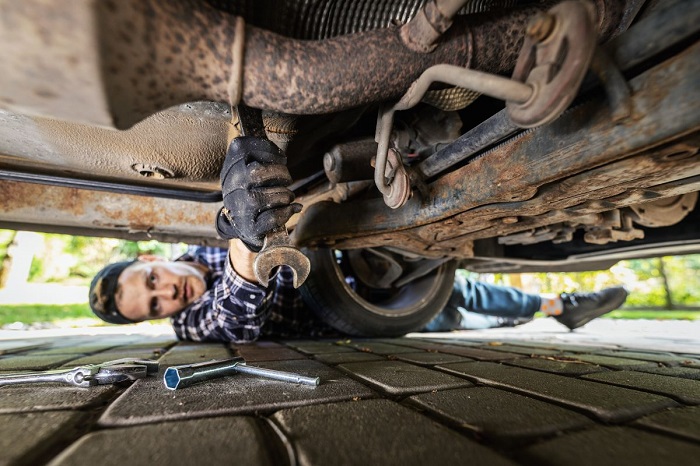
You cannot inspect a chassis while standing on dry pavement in street clothes. Catching problems requires getting directly beneath the rockers and having the leverage to physically probe the metal.
Pack a dedicated inspection kit in your trunk:
-
A high-output LED work light: Smartphone flashlights disperse light too broadly and lack the throw needed to reveal pinholes and hairline fissures inside dark frame pockets. Bring an adjustable LED inspection light rated for at least 500 lumens.
-
A blunt probe or non-marring tool: A standard flathead screwdriver or an automotive panel clip tool allows you to press firmly into questionable areas. Always ask the seller for permission before prodding, framing it respectfully as a standard structural check.
-
A mechanic’s mirror or cheap borescope: Many modern frames rot from the inside out. A telescoping swivel mirror allows you to view the topsides of frame rails, fuel tank straps, and body mounts tucked behind exhaust heat shields.
-
A work mat or cardboard sheet: You will be sliding onto your back on asphalt, gravel, or damp concrete.
-
Nitrile gloves: Rotted undercoatings, road grime, and iron oxide flakes make for a dirty job that ruins ordinary clothing.
High-Risk Zones That Rot First
Automotive engineers design frames with stiffening bends, drainage slots, and overlapping welds. Unfortunately, these exact design features create traps for brine, dirt, and trapped moisture. Focus your flashlight on these critical structural hubs.
Subframes, K-Members, and Suspension Mounting Points
The subframe or engine cradle carries the weight of the powertrain and anchors your lower control arms. If these mounting locations fail, the wheels can separate from their intended geometry at highway speeds.
Inspect the weld joints where the subframe bolts to the unibody rails. Pay close attention to the metal surrounding the mounting bushings; water often pools in the rubber cup, rotting the frame anchor from the inside while the lower lip appears solid.
Boxed Frame Rails and Internal Cavities
Trucks and older body-on-frame SUVs use heavy boxed or C-channel rails. Boxed rails are notorious for collecting road grit washed in through factory access holes. Over years of driving in rain and slush, this debris forms a damp silt deposit that rests inside the bottom plate of the rail.
Run your fingers along the bottom inside edge of the rail where the vertical wall meets the horizontal base. Check both sides of the rear axle arches, as road spray hurled by the rear tires directly blasts the upward curve of the rear frame.
Rocker Panels, Cab Corners, and Pinch Welds
On unibody passenger cars, crossovers, and modern hatchbacks, the rocker panels provide vital longitudinal rigidity. The structural pinch weld running along the bottom edge where you place an emergency jack is a prime failure point.
If the pinch weld crumbles, flattens, or squishes under modest pressure, the internal rocker reinforcement has dissolved. On pickup trucks, examine the rear cab corners and the inner rockers underneath the plastic sill plates.
Strut Towers and Wheel Well Arches
Pop the hood and look down along the inner fender aprons toward the top of the strut towers. Look for hairline cracks in the factory seam sealer. When moisture gets between the layered sheet metal of a strut tower, the metal expands, popping the seam sealer loose.
In severe cases, the strut tower separates completely, allowing the strut assembly to punch upward into the engine bay when the vehicle strikes a pothole.
Pickup Bed Crossmembers and Spare Tire Wells
On pickup trucks, lower the spare tire or shine a light straight up between the rear tire and the truck bed. The transverse crossmembers supporting the cargo bed floor are typically stamped from lighter-gauge steel than the main rails.
These channels frequently turn into red dust while the outer bed looks showroom fresh. On sedans and hatchbacks, lift the spare tire out of the trunk floor and check the bottom of the stamping for pooled water or pinhole daylight shining through from below.
Detecting Deceptive Cover-Ups
One of the most common tricks used to sell a compromised vehicle is masking structural rot with temporary cosmetic covers. Knowing how to identify rushed patches and masked rust saves you from buying someone else’s botched repair.
The most widespread cover-up is fresh, heavy, rubberized undercoating. When an older used vehicle has a jet-black, thick, tar-like undercarriage that looks uniformly clean, be instantly suspicious. Rubberized undercoating should never be applied over active rust. It seals moisture directly against the steel, creating an anaerobic environment that accelerates rot while hiding the destruction under a flexible skin. Press firmly on this black coating. If it feels spongy, soft, or cracks like dried mud, it was sprayed directly over flaking scale.
Be on the lookout for metallic foil tape, expanding spray foam, and polyester body filler sculpted into frame rails. Sellers sometimes shape structural corners with expanding foam, sculpt them with fiberglass filler, and dust the entire repair with flat black paint or truck bed liner.
Tap along the frame with a non-marring tool. Solid structural steel returns a crisp, high-pitched metallic resonance. When your tool strikes filler, foam, or rotted cavities, the sound changes to a hollow, dull thud.
Look at the factory drain slots along the bottom of the unibody rails and rocker panels. Automakers stamp small oval or rectangular holes along low points to let condensation escape. If these weep holes are completely bridged, plugged, or filled by heavy undercoating, the frame rail is trapping water every time the car drives through a rainstorm.
The Systematic Inspection Routine
Approaching a vehicle with a consistent method keeps you from getting distracted by clean trim and skipping hard-to-see areas.
First, take three steps back and look at the car on level ground. Check the vehicle’s stance. Does the body list slightly to one side? Do the wheel well gaps appear uneven between the driver and passenger sides? A sagging suspension or twisted frame can point to collapsed mounts or broken spring perches.
Second, begin at the front bumper and work down one side to the back before crossing over to repeat the process. Start at the front subframe, move across the radiator core support (a common area for road salt spray to pool), inspect the front control arm mounts, and move down the inner rocker panels.
Third, look behind the wheels. Turn the front wheels completely to full lock in one direction. This gives you a clear visual path into the wheel wells without needing to lift the car. Check where the frame meets the inner firewalls and examine the brake and fuel hard lines running along the chassis. Rotted steel brake lines running alongside a frame rail are a reliable indicator of prolonged undercarriage exposure to salt.
Fourth, inspect the interior boundary zones. Lift the floor mats and check the carpet under the pedals and passenger footwell. If the carpet backing feels damp or smells musty, water is likely entering through perforated floor pans or rusted cowl seams.
Deciding Between Negotiation and Walking Away
Finding rust does not necessarily mean you have to abandon the purchase, but it does dictate how you must proceed.
Cosmetic rust on easily replaceable, bolt-on components can serve as a potent negotiation lever. If the vehicle is mechanically sound and the core rails are solid, a rotted bolt-on rear subframe, surface-rusted control arm, or oxidized trailer hitch can simply be replaced with new aftermarket hardware. Factor the parts cost and labor into your counteroffer.
If a seller refuses to let you inspect the undercarriage, forbids you from looking underneath with a flashlight, or insists that a freshly sprayed black underbelly is factory protection, walk away. A reliable frame is the backbone of vehicle safety; if the foundation is compromised, nothing else on the car matters.